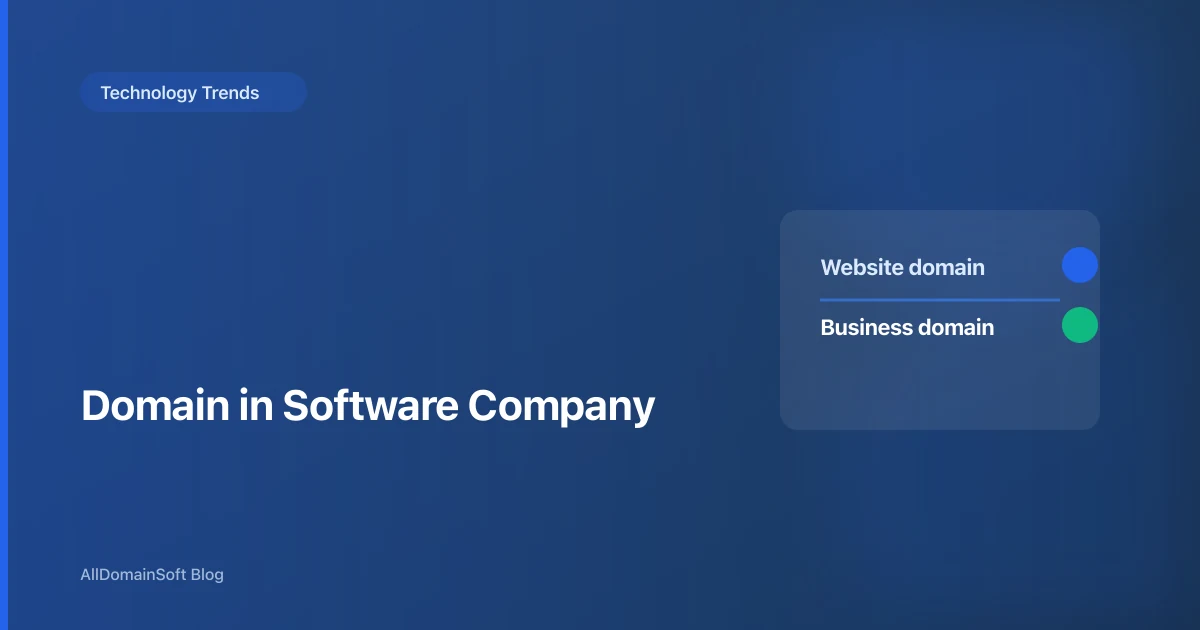
People search domain in company or domain in software company for two different reasons. Sometimes they mean the website domain (the company address on the internet). More often in software teams, they mean the business domain — the industry knowledge your software is built around.
This distinction matters because a good software company is not just writing code. It is learning your domain well enough to make better product and engineering decisions.
Website domain vs business domain
A website domain is the public address: alldomainsoft.com, example.co.uk, or yourproduct.ai. It affects branding, email, and discoverability.
A business domain is the area of real-world knowledge: fintech payments, healthcare claims, logistics, retail inventory, HR payroll, construction estimating, and so on.
When engineers say domain, they usually mean business domain.
What is domain expertise in a software company?
Domain expertise is the ability to understand the rules, edge cases, vocabulary, workflows, and risks of an industry.
For example:
- A fintech developer understands ledgers, reconciliation, KYC, chargebacks, and audit trails.
- A healthcare developer understands patient data, consent, appointment flows, and privacy rules.
- A staffing software team understands roles, availability, timesheets, contracts, payroll, and onboarding.
Generic engineering skill is necessary. Domain understanding is what prevents expensive rework.
Why AllDomainSoft has “domain” in the name
AllDomainSoft means software and staffing across all domains — web, mobile, AI, finance, healthtech, retail, logistics, and internal enterprise tools. We are not a domain registrar and we do not sell website domains.
We build and staff software teams that learn the client’s domain before they write production code.
Domain-driven design in plain English
Domain-driven design (DDD) is a way to structure software around the real business language instead of database tables or random technical layers.
Common DDD ideas:
- Entities — things with identity, like Customer, Invoice, Order
- Value objects — descriptive values, like Money, Address, DateRange
- Aggregates — business consistency boundaries
- Ubiquitous language — the same words used by product, engineering, and operations
You do not need full textbook DDD on every project. But every serious product benefits from engineers who ask domain questions.
How domain knowledge shows up in hiring
When you hire a developer, ask:
- Have they worked in your industry or a similar one?
- Can they explain trade-offs in business terms, not only code terms?
- Do they ask about workflows before proposing architecture?
- Can they model your domain cleanly enough for the product to scale?
A senior who understands your domain can save months.
How we onboard developers into a domain
At AllDomainSoft, new dedicated developers start with:
- Product walkthrough and domain glossary
- Data model review
- Existing workflow and user role map
- Compliance or security notes if the domain is regulated
- First sprint scoped around safe, reviewable changes
This is especially important for offshore teams because written domain context keeps delivery consistent across time zones.
Related reading
- Hire dedicated developers in Gurgaon
- How to protect intellectual property with offshore developers
- Complete guide to offshore development teams
Need developers who learn your domain?
Share your industry, stack, and roadmap. We will suggest a team shape and the domain onboarding plan: contact AllDomainSoft.