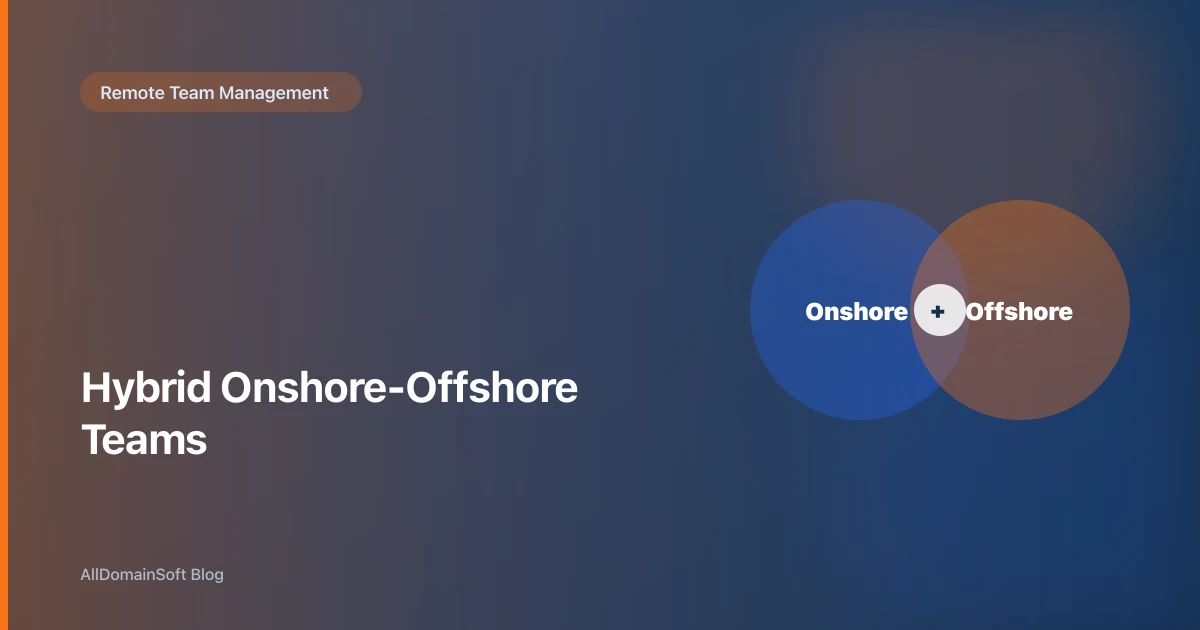
Very few scaling engineering organizations stay purely onshore or purely offshore. The common end state is a blended model: a smaller onshore core paired with a larger dedicated offshore or nearshore team. Done well, this gives you architectural control and client trust plus execution capacity at a sustainable cost. Done poorly, it creates a two-tier culture where the offshore team feels like second-class contributors. Here is how to structure it well.
The role split that works
Keep onshore:
- Product ownership and roadmap prioritization
- System architecture and major technical decisions
- Client and stakeholder relationships
- Security and compliance sign-off
- Final release approval for regulated or high-risk changes
Move offshore or nearshore:
- Feature implementation against clear specs
- QA and test automation
- Bug fixes and maintenance
- Internal tooling and admin systems
- Backend services with documented contracts
- Mobile app feature work
This is not a hierarchy of importance, it is a split based on where real-time context and unplanned decisions matter most.
Communication rhythm
A blended team needs a deliberate rhythm, not ad hoc syncing:
- Daily async standup — written update from every team member, not just a status ping, but blockers and decisions needed.
- One synchronous overlap meeting per day — scheduled inside the shared window (for US/India, typically early morning US time or evening India time).
- Weekly planning call — sprint or Kanban planning with both onshore and offshore leads present.
- Recorded demos — for anything visual, record a short walkthrough instead of relying on a live demo that half the team cannot attend live.
Ownership boundaries that prevent chaos
The most common failure mode is unclear ownership: two engineers in different timezones both think they own the same module, or nobody does. Fix this with:
- A clearly documented owner for each service, module, or feature area
- A single source of truth for requirements (one ticketing system, not scattered Slack threads)
- A defined escalation path when something blocks progress outside working hours
Avoiding a two-tier culture
This is the part most companies get wrong. Signs of a two-tier culture:
- Offshore engineers only ever get leftover tickets, never feature ownership
- Offshore team is excluded from architecture discussions that affect their own work
- All-hands meetings scheduled only in the onshore timezone
- Career growth and promotion paths that quietly favor onshore staff
Fixes that actually work:
- Rotate meeting times so the inconvenience is shared, not always borne by one side
- Give offshore engineers ownership of full features, not just tickets assigned by someone else
- Include offshore leads in architecture and planning discussions, not just execution handoffs
- Apply the same performance review and growth framework to both groups
Governance rhythm for larger blended teams
For teams beyond 8-10 engineers total, add:
- A named delivery lead on the offshore side who is the single point of contact for the onshore team
- Monthly or quarterly business reviews covering velocity, quality metrics, and retention
- A documented replacement and knowledge-transfer policy so a single departure does not stall a workstream
Our guide on offshore developers for UK enterprises covers this governance layer in more depth for larger, regulated organizations.
When to bring in a staffing partner vs building the pipeline yourself
Building offshore hiring, HR, office infrastructure, and compliance from scratch is a multi-month undertaking most companies do not need to take on directly. A dedicated staffing partner that runs an office-based team (not a marketplace of independent freelancers) can shortcut this, providing vetted engineers, office infrastructure, HR, and a replacement guarantee under one monthly cost.